2010 WORLD CUP SOUTH AFRICA

I was asked by a few people if i'd write a blog for the World Cup, from fans who will be watching every kick to people who have no interest in football but know it can't be avoided and could read what i put to help them through or at least make them smile

Friday, 21 May 2010

Greatest World Cup players of all time no. 8 Bobby Moore

Bobby Moore


Born Robert Frederick Chelsea Moore on 12th April 1941, Bobby Moore was the England captain that lifted the World Cup in 1966. for all the great images from English football, Beckham scoring against Greece in 2001, Terry Butcher bloodied and bandaged up against Sweden in 1989 or Gascoigne crying against the Germans at Italia 90, the most enduring and most seen image is the one on the left, the sight of Bobby Moore, England captain, holding the trophy up high as the team he captained hoist him on their shoulders. No image or sight can rival this as the most important in English football history.
Moore was brought up on Wedderburn Road in Barking, Essex, playing football for local school sides. He signed for West Ham as a player in 1956 at the age of 15 as soon as he left school. quickly advancing through the youth system, he played his first game for West Ham on 8th September 1958 against Manchester United. Quickly becoming a first team regular, Moore was greatly admired for the way he was able to read the game and how he was able to anticipate opposition movements, not being a traditional hard-tackling defender, his finesse shone through from an early age. It was this finesse that has led Pele to call him the fairest defender he has ever played against.
In 1962, his form and impact on West Ham's defensive performances as a whole earned him a late call-up to the England squad by Walter Winterbottom and the Football Association committee (between them, the manager and the committee selected the squads in those days) to be included in the squad for the World Cup finals in Chile. Moore still hadn't made his debut for England as he boarded the plane to South America with the rest of the squad, though he did in a pre tournament friendly in a 4-0 win over Peru, impressing enough to stay in the team for the whole tournament (eventual winners Brazil beat England in the semi finals).
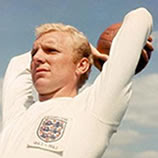


On 29th May 1963, the then 22 year old Moore captained the England national team for the first time in just his 12th appearance, he is England's youngest ever captain (in that game, England defeated Czechoslovakia 4-2).
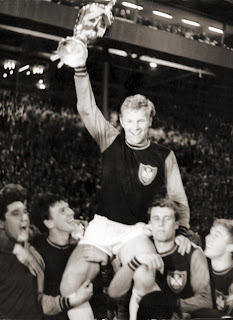
1964 turned out to be an eventful year for Moore, he lifted the FA cup for is club West Ham United after defeating Preston North End 3-2 in the final at Wembley though on a personal level, he was successfully treated for testicular cancer AND was also named Football Writers Association Footballer of the year. (no player has ever endured a season of such highs and lows), though, for Moore, this FA cup success would be the first of three successful Wembley finals in as many years for Moore, the following year West Ham won the European Cup Winners Cup after beating 1860 Munich 2-0.
Though on the verge of his greatest triumph, details were released that Bobby Moore wanted to leave West Ham to join London rivals Tottenham Hotspur, his contract had expired and he didn't want to re-sign for West Ham, his heat was set on a move north west. Only after the intervention of Sir Alf Ramsey (then England manager) did he re-sign for West Ham as he was told differences with his contract would mean not only would he lose the captaincy, also that he wouldn't play at all!


With a hastily arranged contract sorted out with West Ham, Moore was able to lead to lead his country to it's crowning glory as he'd established himself as a magnificent player, gentleman and sporting icon. With all their games at Wembley, England had little trouble getting through a group consisting of Uruguay, Mexico and France. They then beat Argentina in a tempestuous quarter final (Sir Alf Ramsey not letting the players swap shirts after their match due to the dirty way they played, branding them 'animals') http://www.youtube.com/watch?v=W4AakJRRgq0 and through a Eusebio led Portuguese side in the semi finals http://www.youtube.com/watch?v=IsQ8IFHyN6s .


The final was against a side that England had faced twice in two recent wars, Germany (though West Germany after the Berlin wall had been erected).
Remarkably, at least according to Geoff Hurst's autobiography, England full back George Cohen overheard manager Alf Ramsey talking to the coaching staff about the possibility of dropping Moore for the World Cup final to utilise the more battle-hardened Norman Hunter. If this is true or not is unknown but Bobby Moore started the match in his usual position and as captain (it remains a strange scenario, rendered almost unthinkable with hindsight). Moore had been in good form and the only feasible theory would be that the Germans had some fast attacking players which could maybe expose Bobby Moore's lack of pace and that Hunter was the club partner at Leeds United with fellow centre back Jack Charlton.
In the final, 98,000 people crammed inside Wembley stadium to watch , Bobby Moore won the toss and elected to kick off. England went 0-1 down after 12 minutes, Siegfried Held crossed into the England box and Ray Wilson misheaded the ball to Helmut Haller who controlled and shot across the gaol to give the Germans the lead, Jack Charlton and Gordon Banks unable to stop the ball going in. In the 19th minute, Wolfgang Overath conceded a free kick which Moore himself floated into the West German box with pinpoint accuracy to Geoff Hurst who had ran free and was unmarked with no-one around him and headed England level.

The second half started evenly, both teams not wanting to make a mistake and it was England that made the breakthrough on 77 minutes. Winning a corner, Alan Ball delivered the ball to Geoff Hurst who took his shot from outside the box whose shot was deflected into the path of Martin Peters to easily score past German keeper Hans Tilkowski. The Germans pressed for an equaliser in the closing moments, and in the last minute, the referee awarded them a free-kick. Lothar Emmerich took the free-kick which was deflected by the England wall, and across the goal to Wolfgang Weber to level the scores at 2-2 and force the match into extra time. The German equaliser was controversial since the ball had appeared to strike the hand of Karl-Heinze Schnellinger whilst travelling through the penalty area.
With the final going into extra time, both teams looked tired and depleted and having pep talks from their respective managers before kicking off again. In the 11th minute of extra time, Alan Ball broke down the right wing, crossed into the box where Geoff Hurst who controlled and swivelled to make space to shot from close range. The ball hit the underside of the cross bar and bounced down, apparently on or just over the bar, and was then cleared by the Germans. The Swiss referee Goltfried Dienst was uncertain if it had been a goal and consulted his linesmen (Tofik Bakhramov from Russia), after non-verbal communication (as they had no common language), German supporters cite the possible bias of the Soviet linesman, especially as USSR had been defeated in the semi-finals by West Germany and legend has it that when on his deathbed, asked how he could be sure the third goal had crossed the line, he was alleged to have replied 'Stalingrad' (in reference to Germany invading in World War II. In Germany, to this day, a shot that hits the bar and bounces down onto the line is called a 'Wembley-tor' (Wembley goal).

One minute before the end of the game, with England leading 4-2, the West Germans sent their defenders forward in a desperate attempt to score another last-minute equaliser. Winning the ball, Booby Moore picked out the unmarked Geoff Hurst with a long pass which Hurst carried forward while some spectators began streaming onto the field and Hurst scored moments later (claiming he wanted to just kick the ball as hard as he could to send the ball into the Wembley stands in order to kill time, it flew into the top left corner to seal a 4-2 win and to this day, Geoff Hurst is the only player to ever score a hat-trick in a World Cup final. The final goal gave rise to one of the most famous sayings in British sporting history when BBC commentator Kenneth Wolstenholme said 'and here comes Hurst. He's got........some people are on the pitch, they think it's all over. It is now! It's four' http://www.youtube.com/watch?v=twYFgixkqJE

That Geoff Hurst scored a hat-trick overshadowed the fact that a centre back provided two assists for goals, Bobby Moore's performance was masterful. Of the many timeless images from that day, one is of Moore gallantly wiping his hands clean of mud and sweat on his shorts and shirt before shaking the hand of Her Majesty Queen Elizabeth II as she presented him with the World Cup trophy.


The final is the most watched event ever on British television, attracting 32.60 million viewers.

Bobby Moore became a national icon as a consequence of England's success, with him and two other West Ham players taking the World Cup around the grounds which West Ham visited the following domestic season. He was awarded the coveted BBC Sports Personality Of The Year at the end of 1966, the first ever footballer to do so. He was also awarded an OBE in the New Years Honours list.
1970 was a bittersweet year for Moore. He was again named as captain for the 1970 World Cup in Mexico but in a tour before the tournament in south America, Moore was implicated in the theft of a bracelet from a jeweller in Bogota, Colombia. A young assistant claimed Moore removed the bracelet from the hotel shop without paying for it. There was no doubt Moore was in the shop, he had gone in with Bobby Charlton to look for a gift for Charlton's wife, the accusation wasn't proved. Moore was arrested and then released, he then travelled with the England team to play another match in Quito, Ecuador. He played, winning his 80th cap in a 2-0 win, but the plane stopped back in Colombia on as the team were headed to Mexico for the finals. Moore was detained and placed under four days of house arrest. Diplomatic pressure, plus the obvious weakness of the evidence eventually saw the case dropped entirely and an exonerated Moore returned made his way to Mexico to rejoin the squad.

Moore shrugged off the pressure and stress to play a leading role in England's progress through their group. In the second game against favourites Brazil, there was a defining moment for Moore when he tackled the great Jairzinho with such precision and cleanliness that many cite as a tackle that no-one else will ever improve on http://www.youtube.com/watch?v=cMTL9Dm-nYo . Brazil still won the game 1-0 but England still progressed through the group. Moore swapped shirts with Pele after the game, the shirt is now on display in the Priory Collection.
Defeat after extra time against West Germany saw England bow out of the tournament in the last eight, and it would be 12 years before England were to return to a World Cup finals again.

Moore won his 108th and final cap for England in a 0-1 friendly defeat to Italy on November 14th 1973. At the time becoming Englands most capped player of all time (only Peter Shilton and David Beckham have played more games since) and still holds the joint record with Billy Wright for 90 appearances as captain.


Sadly, Moore died on 24 February 1993 at the age of 51, though his legacy lives on, The Bobby Moore Fund has been set up to raise money for research into bowel cancer (which he died of), raising millions for this good cause. The stand replacing the south bank at West Ham's Boleyn Ground in Upton Park was named the Bobby Moore stand shortly after his death. There is also a bronze statue of Bobby Moore erected outside the main entrance of the new Wembley stadium which opened in May 2007, having seen it, it really is a beautiful monument to England's greatest footballing captain.

After his death, in an interview with England's 1966 manager Sir Alf Ramsey, he said,

"My captain, my leader, my right-hand man. He was the spirit and the heartbeat of the team. A cool, calculating footballer i could trust with my life. He was the supreme professional, the best i ever worked with. Without him, England would not of won the world cup"


Germany's Franz Beckenbauer is generally considered the greatest defender of all time, when asked about this he said "Bobby Moore was a real gentleman and a true friend, Bobby Moore was the best defender in the history of the game" and Pele was quoted as saying after Moore's death "He was my friend as well as the greatest defender i ever played against, the world has lost one of it's greatest football players and an honourable gentleman", also noting he only agreed to appear in the 1981 film Escape To Victory if Bobby Moore appeared as well.
World Cup honours:-
1966 World Cup winner

Celebrity World Cup predictions (part two)


Noel Gallagher of Oasis fame has given his backing to Argentina to win the World Cup, mainly as his love of Man City has led him to believe Carlos Tevez is the best player in the world, in fact the guitarist who already has two children plans to pay tribute to his sporting hero when he becomes a father for the third time in September,
"the new baby, if it's a boy - Sara doesn't know yet - is defiantly going to be called Carlos. Yeah, without a doubt. Or just Tevez. Tevez Gallagher. Carlito Gallagher. She doesn't know yet, but I'll nip out to the Marylebone Registry Office while she's having a nap"
The musician has also admitted Sara's pregnancy has scuppered his plans to spend the summer in South Africa for the World Cup, he added in an interview for The Football Association's website,
"I was planning on going but i went and got my missus pregnant didn't I. I should of knocked her up when i got back or something instead"
Noel will be watching the tournament on TV but admits he still gets so involved in the action he frightens his other children
"Anais (9) isn't into football, she thinks it's boring. she can't grasp the concept of Dad's standing up watching the TV, because i do that"


according to the 'black panther' former Portugal striker Eusebio, he rates Czech Republic's chances, saying 'they've got players at teams all across Europe, watch out for them, they are a good team", first time I've heard someone suggest the Czechs as serious contenders, maybe Euesbio is being sponsored by some new Czech beer and has drank too much of it.


and Robbie Fowler has made predictions.....but i don't care

Group E

Today looking at Group E, no easy games in this one


Netherlands


Would Ruud Van Nistelrooy (must of had a long face when he realised he wasn't being picked) and Edwin Van Der Sar of walked into England's squad? yet Holand haven't even bothered to recall the either of the veterans from retirement. This speaks volumes about why the Dutch are the dark horses to win the world Cup this summer. Holland don't just have a squad strong and talented enough, but one which will now be united to go all the way. The stealthy manner of Holland's World Cup preparations is in stark contrast to what is rapidly becoming a chaotic countdown for Fabio Capello's England. That England have been forced to lure Jamie Carragher out of retirement and would of done the same with Paul Scholes smacks of desperation and a dearth of talent, the Lord Triesman debacle and Capello's scoring index only add further confusion to England's preparations, this isn't mentioning the John Terry affair, David Beckham as a coach and resorting at the 11th hour to a 3-5-2 formation. It is all becoming so surreal it's hard not to wonder if Capello has been on a secret spying trip to Amsterdam and enjoyed himself a little bit too much in their famous cafes.
Mind you, take a close look at Holland and there is plenty to space out any of the other favourites including favourites Spain and Brazil.
Not many seem to be taking Holland too seriously, though for what it's worth, they are ranked third in Fifa's rankings which would suggest bookies odds of 10-1 is a very good price.
A more telling statistic is how they got there, winning all eight matches in qualifying in a decent group made up of Norway, Scotland, Macedonia and Iceland.
They did so with a settled side and a totally settled system where every player knows their place. Manager Bert van Marwijk is hardly a big name (not even in Holland (but is in a Scrabble sense)) but he certainly won't be tinkering with things now. The Dutch will play a fluid 4-5-1 formation that is really a 3D 4-2-3-1 system.
After taking over from the high profile Marco van Basten, Marwijk has effectively turned the Dutch into a club side, standing by players even when out of form for their clubs.
since winning the European Championships in 1988, the dutch have usually self-imploded due to a never ending line of divisive splits in the camp. But Marwijk seems to have harnessed all of Holland's natural attacking talent, developed a decent defence and made sure most importantly, there's been no clash of ego's.
Resisting the temptation to recall Van Nistelrooy and Van der Sar has been a vital decision on that front, it has prevented creating resentment and a rift.
Spearhead Dirk Kuyt (with him in the team, they have mastered the art of winning ugly, i can't be the only one that thinks he looks like Rocky from the film Mask (not as funny as the Jim Carrey version) is hardly in Van Nistelrooy's class but the Liverpool man serves the team and will bring the juicy attacking trio of Robin van Persie, Arjen Robben and Wesley Sneijder into play. There is quality in depth too. This would seem to be the Netherlands best chance of lifting the World Cup since losing the finals of 1974 1978.
With the added bonus of the historic Boer support in south Africa, the dutch might just have the courage to see their total football win a world cup at last.
Interesting fact, Holland has the highest museum density in the world, with almost 1000 museums. Also, there is a little village called Rectum, bet it's a s***hole
National dish, stamppot, made from a combination of potatoes mashed with one or several other vegetables, sometimes also with bacon. Green mashed potatoes....I'm not Popeye, I'll have the fries please Wimpy.
Denmark


Now in his 10th year as manager of Denmark, and guiding Denmark to their second World Cup in his tenure and also the only person to achieve 100 international matches as both a player and a coach, for all their legendary players like Peter Schmeichel, the Laudrup brothers and Poul Nielsen, it's Morten Per Olsen that is characterised as the most important person in Danish football history.


The Danish squad itself is good, but not great. Expect captain Jon Dahl Tomasson to equal and maybe break the all time Danish goalscoring record, currently one behind Poul Nielsen who scored 52. Tomasson who is enjoying his last hurrah in the Danish squad at the age of 33 will be aiming to go out on that personal high, with competition from Arsenal's Nicklas Bendter (an Andy Cole for the 21st century) and Ajax's Dennis Rommedahl, they have no shortage or centre forwards who have the potential to perform on the grand stage.
In midfield they have Juventus' Christian Poulsen who combativley breaks down opposition attacks and sets his own team on the way, mainly to Thomas Kahlenberg of Wolfsburg and Daniel Jensen of Werder Bremen.
Defensively though, they lack the real quality needed to cause a threat at the tournament, Liverpool's bit part player Daniel Agger is joint most experienced defender they have with 29 caps, the other being Blackburn's Lars Jacobsen. I'd like to see Malaga's Patrick Mtiliga given the chance after making his debut way back in November 2008 and only having the one cap to his name.
In goal, a lot rests on the fitness of Stoke City's Thomas Sorenson who dislocated his elbow in the game against Chelsea last month, without him, they will be relying on FC. Copenhagen's Jesper Christiansen who only has 10 games played for his country.
Ultimately, the Danes will know qualifying from the group is as much as they could ask for, they're not expecting the team to bring home the bacon.
Interesting fact, the most famous Dane is Hans Christian Anderson, who's books have been translated into more languages than any other book bar the bible....shows fairy tales sells well.
National dish, i would of thought bacon (no offence to any police reading (not you Sting)) but it's frikadeller, flat, pan-fried dumplings of minced meat.


Japan


After Ivica Osim suffered a stroke in December 2007, Takeshi Okada stepped back into the limelight to manage his native Japan again after previously guiding them to France 98 (which was the first time they had qualified, finishing bottom of a group with Argentina, Croatia and Jamaica, 4 years later on home soil, they won their group with Belgium, Russia and Tunisia, knocked out by Turkey in the second round). But how will they do at this tournament? drawn into a group where they find 3 superior (on paper at least) teams, recent years have also seen Japanese players seen less in the teams of so called bigger clubs, in fact the 23 man squad for Japan includes only 5 players that play outside of Japan.
Portsmouth may remember with a tongue in their cheek Yoshikatsu Kawaguchi, his performances in English football may of been questionable but his experience with 116 caps for Japan mean he's been bought in as cover for no. 1 Seigo Narazaki (himself with 75 caps to his name).
Defensively, they really on the likes of FC Tokyo pair Yasayuki Konno and Yuto Nagatomo, working alongside national captain Yuji Nakazawa of Yokohama F. Marinos.
Midfield sees CSKA Moscow's Keisuke Honda (who only joined in the new year and has yet to really impress), though I'm sure Celtic fans will remember Shunsake Nakamura, Japans's talsiman now plays back in his home country (Yokohama F. Marinos) and at 31, this should be the stage he makes a mark but i have to wonder about his appetite for success in returning to his native country so early.
All is not lost in attack, they have 24 year old Shinji Okazaki, he's spent his entire career so far at Shimizu S-Pulse and I'd like to see him step up and show what he is capable of, 16 goals in 25 games so far suggests he has talent.
Overall, it's hard to decide if Japan are in transition or simply lack the quality to compete anymore, following the success of England's Premiership in their country, money has been pumped into their own football league and i fear this lack off quality against better quality teams for key players will cause them to finish bottom of this group, they don't seem to have the quality, when one of the main stars is Junichi Inamoto, who never impressed at Arsenal, Fulham or West Brom, this shows why
Interesting fact, Tokyo has had 24 recorded instances of people either killing themselves or receiving serious skull fractures while bowing to each other with traditional Japanese greeting (doesn't happen with a hand shake.....though you often look at the person and wonder where the hand has been)
National dish, sushi (you get a raw deal eating that stuff)


Cameroon

Never a team to be underestimated, Cameroon has qualified for the World Cup 6 times, more than any other African nation. They were also the first African side to reach the quarterfinals, losing in extra time to England in 1990. They have also won the African Cup Of Nations 4 times as well as the gold medal at the 2000 summer Olympics.
Managed by former Rangers manager Paul Le Guen, Cameroon feature a team with genuine world class players to players struggling to make it at club level. Thir main man is striker Samuel Eto'o, the nation's captain having scored 43 goals in 92 appearanmces, he is his countries greatest ever goalscorer though next highest scorer is Mallorca's Pierre Webo (Cameronnian for Peter Parker?) with just 13 in 39, this inconsistancy runs through the team. In midfield they have the likes of Arsenal's Alexandre Song and Lyon's Jean Makoun, two players plying their trade at the highest level, but then supported by players like FC Augsberg's Marcel Ndjeng, 28 years old and never won a cap! this is a team in transistion.
Having the teams highest ever goalscorer, they also include Rigobert Song, formerly of Liverpool and West Ham, their highest ever capped player with 133 games under his belt and first played in the World Cup way back at France 98. With Geremi Njitap alongside him who has 109 caps, defensively they may be the most experienced centrebacks in the history of the World Cup finals with 242 caps between them, but they have lost the yard of pace they once had and need all their experience if Cameroon are to progress.
In goal though, they have a reliable keeper in Carlos Kameni, he's been the first team goalkeeper at Espanyol for 6 years and at the tender age of 26 and with 58 caps to his name, if he impresses, he could make a move to a bigger side.
This team can spring a surprise on many teams but if they make the 2nd round, they'll have achieved all that can be expected of them, but they won't go down without a fight.
Interesting fact, Cameroon are ranked 19th in the world by FIFA, the only African team higher is Egypt at 13th
National dish, Ndole, a stew of nuts, bitter leaves indigenous to West Africa and either fish or ground beef.......can't be worse than a kebab on a Saturday night i guess.

Thursday, 20 May 2010

Greatest World Cup players of all time no. 9 Guiseppe Meazza

Guiesppe Meazza


Born in the Porta Vittoria, Milan on 23rd August 1910, Guiseppe "Peppino" Meazza is simply the greatest Italian player of all time. Scoring 33 goals in 53 games and winning the World Cup twice.


Having lost his father in 1917 during the First World War, young Meazza grew up with his mother, helping her to sell fruit at the local market. However, even from this age, it was clear that football was his true calling though his mother used to hide his shoes in an effort to stop him playing all the time, thus Meazza used to spend much of his time playing barefoot. At 6 he began playing on the streets for the 'Maestri Campionesi' team, playing with a ball made of rags and not until he was 12 years did he finally achieve permission from his mother to actively pursue becoming a footballer, beginning to learn his trade at local club Gloria F.C., his mother unable to afford actual football boots, it was a local fan that bought him his first pair.

At 13, Meazza dreamed of playing for A.C. Milan, winning a trial with them but was rejected for being too skinny.After being noticed by a scout from Italian giants Internazionale of Milan (Inter Milan) juggling a ball rag in the street he was soon signed up. They continually fed him a diet of steaks so he would get bigger and stronger. In 1927, the then 26 year old striker Leopoldo Conti was surprised to hear he was dropped to make for the 17 year old Meazza, thinking he was far too young to be even associated with the first team after Inter coach Arpad Weisz selected him, 'Now we even take players from kindergarten!' he exclaimed sarcastically (inreference to The National Opera Balilla, the fascist youth organisation which collected all children aged between 8-14). Meazza scored two goals on his debut against Milanese Inione Soprtivo in a 6-2 win, leaving Conti speechless. The 'Gazzetta dello Sport' the following day (12th September 1927) highlighted his performance as 'intelligent, fresh and quick', praise like that didn't happen very often in those days.

He began his career as a striker but showed his skill to become an attacking midfielder, he was a great leader who had amazing shooting and dribbling skills, an eye for a pass and despite his relative small height, exceptional heading ability.

Meazza still holds the Italian record for most goals scored in a debut season in Serie A, scoring 31 goals in the 1929-30 season (the year before, Serie A didn't exist, the Italian championship was contested of teams leagues, north and south, with a playoff with the winners of both leagues to decide the all Italian title). In this final season of the old 2 league system, Meazza played 29 games and scored 38 goals, all at the age of 18 (what price now for a player that could achieve that?). He scored 5 goals in a single game twice in this season (against Pistoiese and Verona) and on 12th May 1929, scored 6 goals as Inter beat Venezia 10-2. On 27th April 1930, on the first time Inter ever played AS Roma in Milan, Inter won 6-0 and Meazza scored four of the goals, the first three he scored in the first three minutes of the game.

With Meazza firmly in the squad, Inter (re-christened Ambrosiana while under fascist law) won 3 national titles in 1930, 1937 and 1940 and helped the team win it's first ever Coppa Italia in 1939. It was Meazza's dazzling form that clinched the inaugural Serie A title, in the deciding game, he scored a second half hat-trick in the game against Genoa after Inter were trailing 0-3 at half time. He was top scorer of Serie A in 1930, 1936 and 1938.


During the 1932-33 season, Meazza made a bet with Giampiero Combi, the goalkeeper of Juventus and 1934 World Cup captain for Italy. Combi challenged Meazza as he claimed no-one could sidestep him to take the ball round him and score a tap in goal, Meazza accepted the challenge. Combi then also made another bet, a few weeks earlier, while training for the national team, Meazza scored a apparently all too memorable bicycle kick against the Juventus stopper, Combi made the claim he couldn't repeat the goal in an official match. The next game between Ambrosiana Inter and Juventus on 25th May 1933, Meazza managed to score two absolutly stupendous goals, the first was an identical overhead kick to the one he had scored against Combi in training a few weeks earlier. The second goal, Meazza dribbled past 4 defenders, before faking a shot at Combi who dived too early, Meazza dribbled past him and scored a tap in. Combi immediately stood up, took his gloves off and through them on the floor in disgust and went and shook Meazza's hand.

Meazza was the first Italian football player who became famous worldwide and was the first also to have personal sponsors. He loved the social nightlife this gave him and also was partial to champagne and the women that came with this. It should also be noted he was the only player on the national team that was allowed to smoke. Meazza was famous for not only humiliating the best defenders Italian football had to offer at the time, but also for sleeping in brothels the night before a match and sometimes he would refuse to get out of bed until his teammates were already done practicing (George Best anyone?). It's often said his love of the tango enabled him to score goals at a fox-trot tempo. He was a superb dribbler and despite his speed, never had a Brylcreemed hair out of place (David Beckham anyone?). His trademark goals would be where he'd collect the ball at the half-way line, dribble past several opponents with a series of twinkle-toed shuffles, turns and feints until arriving in front of the goal.....then dribbling past the keeper to slot easily into the net(Diego Maradona anyone?). In away games, the defenders would often hack him down and foul him (Leeds United anyone?) and in Italy the phrases 'Gol alla Meazza' and 'finte alla Meazza' have since become popular sayings for Italian football fans to describe a sensational goal that involves a long dribble.

Sometimes his love of champagne and women would cause trouble with the board of directors, 'luckily, i lived near the stadium and i often managed to get there in a rush. My teammates and the coach looked at me disapprovingly, it was only 5 minutes before the kick off, so i quickly changed and joined the team on the pitch. I could hear the Inter directors saying "We'll deal with him after the match, we'll find out what he's been up to", luckily i scored a hat-trick so afterwords no one said a word' he was quoted as saying in an interview after his retirement and reflecting on his career.
These incidents became a common occurrence, in the final game of the 1936-37 season, Inter needed to beat Juventus in Milan, with only an hour before the kick-off, Meazza still hadn't shown up. The directors getting nervous, they sent out a masseuse and one of the trainers out in a car to find him. They soon found him in bed, fast asleep and snoring. Without even washing his face, they dragged him out of bed and into the car, lying in the back, Meazza described the previous nights love filled exploits and said he felt like a lion! this lion Meazza entered the dressing room and with not a word said, was given his number 9 jersey. He took to the field and scored 2 goals and won the man of the match award. Inter won the game 2-1 and beat Juventus to the Serie A title by two points.

Injury forced him to miss most of the 1937-38 and after devoting his career so far to Inter, Meazza was transferred to AC Milan on 28th November 1940. In almost a century of intense rivalry, Meazza is the only player that has ever come close to bridging the differences between the two clubs. In the next derby between them, Meazza cried in the dressing room but then scored the equaliser for Milan in a 2-2 draw. He wore the red and black of AC Milan from 1940-1942, later playing for Juventus, AS. Varese 1910 and Atalanta Bergamo. After the war in 1946, he was recalled to Inter as a player coach, he played 17 more games for them and scoring the last 2 goals if his career to help a relegation threatened Inter side.

But it's his national record that makes him my 9th greatest player in the history of the World Cup, playing for Italy in the 1934 and 1938 World Cups, both of which Italy won. In 1938, he bacame the first captain to lift the World Cup when not the host (tournament was held in France)
and along with three other Italians players, remains one of four Europeans to win the World Cup back to back.

His debut with the Azzuri (nickname for the Italian side) was in Rome on February 6th 1930 against Switzerland. Still just 19, Meazza scored twice in that game to help Italy to a 4-2 win (after being 0-2 down in the first 19 minutes).
In the 1934 World Cup which was hosted by Italy, Meazza appeared in every game. Scoring the opening game against United States in the 89th minute in a 7-1 win. In the semi finals, Italy came up against the Wunderteam, the great Austrian side of the 30's who had already beaten the Italians in Turin only 4 months earlier. An few hours before kick off, a deluge of rain left the San Siro pitch looking like a bog but Meazza, knowing this ground better than anybody on the Italian team, made light of these conditions, inspiring a performance in his fourth game in a week, Meazza out played an Austrian forward in his own half, dribbled past him, then collided into the Austrian keeper Peter Platzer and the ball bounced and came loose, hit the post and bounced to Enrique Guaita to score the only goal of the game.

55,000 fans turned out to see the final against Czechoslavakia in Rome. Italy suffered badly after Meazza was injured badly in a tackle but in an era before substitutes, he soldiered on. In the 54th minute, he punched Rudolf Krcil in the liver in retaliation for the earlier hard foul though neither was disciplined by referee Ivan Eklind. After 90 minutes the teams were level at 1-1. It was Meazza that became the inspirer in the 96th minute, Eraldo Monzeglio passed a long ball to the hobbling Meazza who had been left alone on the right wing, with time and space, he sent a pass through the defence to Guaita that unlocked the Czech defense who then dribbled for the final cross to Schiavo who hit a snap shot to secure the win 5 minutes into extra time. Meazza was elected into the All Star team of the tournament and won the Golden Ball as well.

In the 1938 World Cup, Meazza this time captained Italy to another victory, again playing in each of the games. One of the tournaments memorable moments is the goal he scored against Brazil in the semi final, after a penalty was awarded for a foul on Silvio Piola, the Brazilian goalkeeper Walter, who was famous for attempting to hypnotise his opponents and for saving penalties back in Brazil, he arrogantly claimed he would save the shot. Up stepped Meazza who made no fuss in taking the shot. As he stepped up, his shorts fell down as the elasticated waist had earlier been pulled and ripped by a defender, Meazza then without a hint of stress, simply held his shorts up with one hand as the took the shot and scored past a confused Walter, who was still too busy laughing, the goal sending Italy to their second consecutive final (if anyone can find footage of this, please let me know as i have looked and really want to see this). It was his last goal for Italy. In the final the Italians beat the famous Hungary side 3-1, Meazza setting up two of the goals http://www.youtube.com/watch?v=4BUS45nTOZM&feature=related . In total he played 53 times for Italy, scoring 33 goals and losing only 6 matches. He is the second highest scorer for the Italian national side, only beaten by Gigi Riva in 1973.

Vittorio Pozzo, the coach who masterminded both Italian World Cup wins wrote of him "He was a born centre forward, understood the situation, distributed the ball careful and made the team offence operate. Having him on the team was like starting the game 1-0 up"
During Sweden 58, during the final between Sweden and Brazil, one commentator said Pele was like no player he'd ever seen before, fellow commentator Franco Rossi (who later went on to have huge success as a film screenwriter and director) began screaming that this wasn't true, that Meazza was better.


Most notably is the fact that in 1980, the year after his death, the world famous San Siro was officially named The Stadio Giuseppe Meazza, shared by both Inter and AC Milan


World Cup honours:-

1934 World Cup winner

1934 World Cup Golden Ball winner (best player)
1938 World Cup winner (as captain)

Tuesday, 18 May 2010

Group D

Today looking at Group D and looks at what could be a very difficult group for all concerned


Germany

Three times champions Germany, the team that always has a nation that doesn't expect and become a nation that over exceeds. coach Joachim Low was Jurgen Klinsmann's assistant at the last world cup, bought in to supplement Kinsmann's attack mentality as a more talented tactician to help supplement Klinsmann's ideas. When Klinsmann stepped down after the 2006 tournament, Low took sole charge and has impressed greatly, beating England 2-1 at the newly opened Wembley and qqualifying for Euro 2008 in style, as one of the favourites, he guided the team to the final, only losing to current World cup favourites Spain 1-0.


(I have read that there are a lot of problems in Germany with football hooligans where they are actually being caused of Polish hooligans crossing the border to cause mayhem, talk about chickens coming home to roost)


So with this in mind, they have to be considered dangerous at the footballing event and a team England could well face in the second round.
The German squad will consist of players all playing in their native country, with captain Michael Ballack injured, it means Chelsea's midfield general (i think i got away with it but don't mention the war) won't make what would most likely of been his final World Cup. Defensively the Germans as ever are well organised and tough to break down, Werder Bremen#s Per Mertesacker already has 60 caps to his name at only 26 though Munich's Philipp Lahm is the same age and on 64. In goal they miss their number 1 choice Rene Adler of Bayer Leverkusan due to a serious rib injury which means between the selected three of Hans-Jorg Butt (Bayern Munich), Manuel Neuer (Schalke) and Tim Wiese (Werder Bremen), the Germans are relying on goalkeepers with just 8 caps between them. (first choice would of been former Hannover player Robert Enke but his suicide on November of last year proves how sadly he is missed)
Attack wise they have plenty of options, Miroslav Klose has 94 caps to his name and 48 goals, that's more than 1 in 2 games, Lukas Podolski, 37 goals in 71 games, Mario Gomez 11 goals in 32 starts. Strong attacking options supporting in midfield through the likes of Bastian Schweinsteiger of Bayern Munich and Piotr Trochowski of Hamburger SV. Overall, this is a team that can achieve and one bigger nations will be happy to avoid, expect a traditional strong rigid team that will be well organised and expect to do well. Without Ballack and that goalkeeping experience, they shouldn't go all the way......but then how many times has that been said about Germany?
Interesting fact, there are 1,300 beer breweries in Germany, making some 5,000 kinds of beer. German people are the worlds third largest beer drinkers after the Czechs and the Irish
National dish, sauerkraut (that was a German that was bad at losing), a finely shredded cabbage that is fermented through various means and has a long shelf life, looks rotten and tastes rotten to be honest


Australia


Australia, managed by Dutchman Pim Veerbek who was Guus Hiddink's assistant at South Korea in 2002 (who finished 4th), and took over from him for a year before becoming head coach of Australia in 2007. Competing in only their 3rd World Cup finals (only ever winning one game against Japan 4 years ago).


With a squad base from all over the world, including many from England, it's not hard to see them playing a flexible English style of football but who are the players to look out for?
In goal, it's easy to underline just how good a goalkeeper Mark Schwarzer is, reaching what is now the Europa League final with two unfancied sides in Middlesbrough and Fulham, his experience with 73 caps (4th most capped Australian of all time) shows he can be a tough player to beat on his day but at 37, it'll be interesting to see how he copes in such a major tournament.
Defensively they rely too much on Scott Chipperfield (Basel) and Lucas Neill (Galatasary), though good solid player, if one gets injured then frailties do begin to show.
They have a wealth of talent in midfield, working as hard as any team in the competition, most notably Everton's Tim Cahill who if fully fit will be a player to watch with Blackburn's Brett Emerton as the holding midfielder.
Attack wise is where Australia show their main weakness, no player in the side has scored more than 20 goals, Middlesbrough striker Scott McDonald has still to score in 15 games and they rely too heavily on Harry Kewell (who may still not make the final cut due to injury)
Expect the Australians to admirably hold out for as long as possible but in the final 30 minutes of games they can easily come undone but with passionate support they will be enjoyable to watch as they try to match the worlds best.
Expect Walkabout to push the Australian matches and as ever for football matches, a place to avoid from all the fake Aussies
Interesting fact, there are more than 150 million sheep in Australia and only around 20 million people.
National dish, barbecues, roast lamb, Vegemite, the lamington, take your pick (though i'd advise not to pick the Vegemite)


Serbia


Following 4 years in retirement, Serbian manager Radi Antic made a name for himself in Spain, managing both Real Madrid and Barcelona in his time there, now, at 61, he has taken charge of the team formerly known as Yugoslavia, Serbia qualified top of a tough group containing France, Austria and Romania.


The Serbians are a well organised team and their group games will be close to say the least, the games against Germany and Ghana in particular are mouth watering prospects.
In attack they have Nikola Zigic of Valencia, having scored 16 goals in 42 games and at the age of 29, he is very much a dark horse contender for the Golden Boot, with Ajax's Marko Pantelic and Zenit St. Petersburg's Danko Lazovic, this is a team that will threaten to score against any team, particularly at set pieces. The attack is mainly led by national captain Dejan Stankovic of Inter Milan and the ever improving Zoran Tosic of Manchester United, the team will fly at defences and create chances though the team have huge depth of strength in defence, arguably one of the best defenders on the planet, Manchester United's Nemanja Vidic, assisted by the likes of Chelsea's Branislav Ivanovic and Real Zaragoza's young full back Ivan Obradovic, they will be hard to get past but if attackers do, and this is the Serbians real weak point, in goal they'll most likely find Vladimir Stojkovic, who wasn't even first choice goalkeeper when on loan to Wigan Athletic last year. It's because of this that Serbia aren't being touted as potential World Cup winners.
Interesting fact, Serbia is a landlocked country, no beaches, no Navy, less chance of drowning
National dish, cavapci'ci, consisting of grilled heavily seasoned mixed ground meat patties.....basically sounds like a burger


Ghana
Ghana are a team ranked 13th in the world by Fifa, that should show how much is expected of them, especially on their home continent, ably managed by Serbian Milovan Rajevac who led Ghana to the 2010 African Cup Of Nations (losing 1-0 to Egypt in the final)
What i find interesting is the match against Serbia, moth nations managed by a Serb and where Serbia have Wigan's third choice goalkeeper, Ghana have their reserve keeper in Richard Kingson.
With vast experience in defence through Sunderland's John Mensah (62 caps), Fulham's John Pantsil (58 caps), Roda JC's Eric Addo (45 caps) and Bayer Leverkusen's Hans Sarpei (28 caps), Ghana play as a good strong defensive unit but their real strength is in midfield, Chelsea's Michael Essien is one of the best midfielders in the world, with Inter Milan's Sulley Muntari (though his relationship with Ghana has been rocky at times) beside him, this is one tough midfield to get through. In attack, Asamoah Gyan has scored 19 in 38 games with NAC Breda's Matthew Amoah making a formidable front two.
Interesting fact, shop names in Ghana enjoy names like 'Anointed Hands Cake Decorating', 'Ask The Lord Beauty Sleep', 'Jesus Lives Radiator Shop' and my personal favourite, 'God Heals Fast Food'
National dish, jollof rice, basically chicken with rice, like a healthy KFC, remeber, God heals fast food
This group has to be the closest of all the groups, 4 teams that can genuinely beat each other on their day and to maybe say Australia are the weakest team shows how competitive this group is, expect close combative games and a surprise or two

Monday, 17 May 2010

Greatest World Cup players of all time, no. 10 - Jairzinho


Jair Ventura Filho, aka Jairzinho was born on December 25th 1944 in Brazil's capital, Rio De Janiero where he went through the youth setup at local club Botafogo (making his professional debut with the club at 15). His hero Garrincha, who he would eventually replace for both club and country, also played at Botafago, albeit in Jairzinho's preferred position on the right wing. This resulted in Jairzinho playing most of his early career as a left winger or centre forward though when Garrincha was was injures, he would fill in as a right winger, by far his stongest position.


Jairzinho made his interantional debut as a 19 year old in 1964 against Portugal (again, when Garrincha was injured). He made his World Cup debut at England 66 though with Garrincha back in the side, he was used as a left winger and struggled to be effective in this role (Brazil were eliminated in the group stage after being beat by Hungary and Portugal). After the tournament, Garrincha announced his retirement from international football and Jairzinho was able to take over his idol's role on the right wing for Brazil.


Now playing in his favoured position, Jairzinho bacame a far more effective player for his country. At Mexico 70, with arguably the greatest team that ever played, he was part of the Brazil team that won the World Cup and Jairzinho made history by scoring in every game for Brazil (his seventh goal in the final, against Italy in a 4-1 win, wasn't enough to secure the Golden Boot, that went to West Germany's Gerd Muller who scored 10 goals. Jairzinho later claimed that FIFA awarded him a "best body on the planet" award for his athletecism).


Jairzinho scored two goals at Germany 74 which would prove to be his last World Cup for Brazil, though he did continue playing for Brazil for another 8 years (33 goals in 81 games from 1964-1982).


Following his retirement Jairzinho become a coach and later head coach for the Gabon national team, though perhaps his greatest achievement as a coach was spotting Ronaldo as a 14 year old whilst playing for Sao Cristavao, kick starting the future three-time FIFA World Player of the Year winner by recommending him to Cruziero


World Cup honours:-


1970 FIFA World Cup winner


1970 Best Player World Cup (Hurricane Cup)


In 2000, he was listed at number 27 in World Soccer Magazine's list of 100 greatest players of the 20th Century, one place ahead of Zinedine Zidane


Sunday, 16 May 2010

New manager for France after the World Cup! Vive La Blanc

This past Sunday it was announced on Bordeaux's website :-


"Girondins Bordeaux have been informed by Laurent Blanc that he wanted to answer favourably to the French Federation (FFF)'s solicitation to become French coach.

Girondins Bordeaux expect to hear from the FFF on the question of the compensation of the release of their coach"


What this means is that after the World Cup, current coach Raymond Dommench will be stepping down, much to the fans delight. He has long bore the brunt of fans' frustrations following a disappointing Euro 2008 campaign where France picked up only one point and finished bottom of their group. In qualifying for this World Cup, they finished 2nd in their group behind Serbia and had to cheat past Republic Of Ireland to qualify. It's the way the French play, the lack of conviction that the fans don't like and it's no surprise the FFF have decided to alter things after a tournament where France aren't expected to achieve too much success.


Laurent Blanc was a member of the hugely successful French squad that won the World Cup on home soil in 1998 and 2 years later Euro 2000. Blanc had a terrific career as a centre back for Barcelona, Marseille and Inter Milan and won the Premiership with Manchester United in 2003.

Having played 97 times for the national side and after achieving the Frnech league and cup double with Bordeaux last year (though should be noted this year they didn't even qualify for Europa League), it's an interesting appointment but after 3 years as a manager, is it a step in the right direction?


The departure of Dommenech isn't met by cheers from everyone, French captain Thierry Henry, has been very open in his distaste for this announcement being made before the World Cup (this is the same Henry who recently signed a contract to play for New York Red Bulls next season while still trying to win the league with Barcelona this season i might add).


Already rumours are spreading of where Dommench will be next season, with people predicting he may take the Liverpool job, though he didn't seem to be aware he was being replaced, when told of the news he was surprised and said "I'm not the one who decides on this, Blanc proved he was able to coach at club level. But coaching a national team is a different job. He will have to be ready immediately because the Euro 2012 qualifying campaign starts in September".


The French federation is expected to officially confirm Blanc as Dommenech's succesor on Thursday.